
Water damage restoration is a structured process that returns a water-affected structure to its pre-loss condition. It goes beyond removing visible water; it addresses moisture trapped inside walls, floors, and ceilings that causes long-term structural deterioration and mold growth.
For contractors and property owners managing a water damage equipment rental in Los Angeles, understanding each phase of restoration helps ensure the right equipment is deployed at the right time. Skipping or shortening any phase leads to incomplete drying, failed inspections, and recurring damage. This guide covers what restoration actually does at each stage and how LA Restoration Rentals supports the full process across Los Angeles.
Phase 1: Water Damage Assessment and Classification
Every restoration project begins with a formal assessment. Certified restorers use moisture meters, thermal cameras, and thermo-hygrometers to map the full extent of water intrusion before any equipment is placed. This step determines the water damage category and class, which directly dictates the equipment type and drying timeline.
The IICRC S500 standard defines three water categories:
- Category 1: Clean water from supply lines or rainfall with no immediate health risk.
- Category 2: Gray water from appliances or overflow with potential biological contamination.
- Category 3: Black water from sewage or floodwater carrying pathogens and requiring full containment protocols.
Water damage class ranges from Class 1 (minimal absorption) to Class 4 (specialty drying for dense materials like concrete and hardwood). Misclassifying the damage class results in under-equipped drying setups that extend project timelines beyond the IICRC’s standard 3- to 5-day drying window.
Phase 2: Water Extraction
Extraction removes bulk water from affected surfaces before drying equipment is deployed. Standing water left on floors and in cavities slows the evaporation phase and increases the total moisture load the dehumidifiers must process. Truck-mounted extractors generate vacuum pressure between 150 and 200 inches of water lift, pulling water from carpet, padding, and porous flooring materials in a single pass.
Portable extractors are used in areas inaccessible to truck-mounted units, upper floors, tight corridors, and rooms with limited entry points. The extraction phase is considered complete when no free-standing water remains and surface moisture readings drop to a level where evaporative drying can proceed efficiently. Extraction alone does not dry a structure. It reduces the moisture load so that dehumidifiers and air movers can complete the drying process within the target window.
Phase 3: Evaporative Drying with Air Movers
Air movers accelerate evaporation by increasing air velocity across wet surfaces. High-velocity air reduces the boundary layer of saturated air that naturally forms above wet materials, allowing moisture to evaporate faster into the surrounding air volume. Commercial air movers used in restoration produce airflow between 1,500 and 3,000 cubic feet per minute (CFM) depending on the unit model.
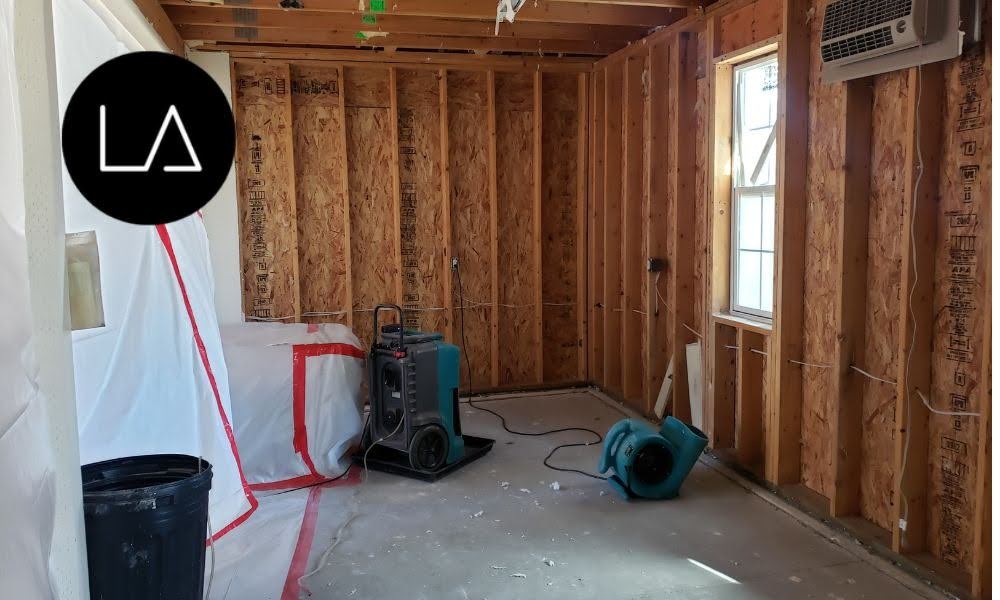
Placement follows the vortex drying method, where air movers are positioned at 45-degree angles along the perimeter of the room. This creates a circular airflow pattern that lifts moisture off floor and wall surfaces simultaneously. Research supported by the Indoor Air Quality Association confirms that vortex placement reduces drying time by 20 to 35% compared to linear placement methods. Air movers work in tandem with dehumidifiers without dehumidification running simultaneously; elevated humidity from evaporation simply redistributes moisture rather than removing it from the structure.
Phase 4: Structural Drying with Dehumidifiers
Dehumidifiers remove moisture-laden air from the drying chamber and discharge dry air back into the space. LGR dehumidifiers lower the dew point of processed air below the evaporator coil temperature, allowing the unit to extract moisture even at low ambient humidity levels. This makes LGR units the standard choice for structural drying in Los Angeles, where indoor RH can drop quickly and conventional refrigerant units lose efficiency.
Desiccant dehumidifiers use silica gel rotor technology to absorb moisture chemically rather than through refrigeration. They perform at low temperatures and low RH levels where LGR units approach their operational limits. The Department of Energy’s Building Technologies Office documents that desiccant systems maintain consistent moisture removal capacity at RH levels below 40%, making them effective for deep structural drying in dense materials like concrete block and engineered lumber.
Phase 5: Monitoring and Documentation
Restoration does not end when equipment is placed. Daily monitoring tracks whether drying conditions are progressing toward the target equilibrium moisture content (EMC). Technicians record temperature, RH, and material MC readings at consistent intervals using calibrated instruments.
Monitoring data serves two purposes:
- It confirms the structure is drying within the projected timeline.
- It provides documentation for insurance claims and project closeout records.
The IICRC S500 requires that drying logs capture readings at a minimum of once per 24-hour period. Los Angeles insurance adjusters increasingly require psychrometric data as part of the claims documentation package. Projects without monitoring records face delayed claim approvals and disputes over drying scope.
Phase 6: Controlled Demolition and Material Removal
Some materials cannot be dried in place. Wet drywall below the saturation line, soaked insulation, and buckled flooring must be removed to expose the structural cavities behind them. This phase is called controlled demolition or “flood cuts.” Restorers cut drywall at a measured height above the visible water line typically 12 to 24 inches to expose wall cavities and allow air movers to dry the framing and insulation directly.
Insulation holds moisture at levels that surface drying cannot address. Fiberglass batt insulation absorbs water and compresses, losing its thermal resistance and creating a sustained moisture reservoir inside the wall cavity. Spray foam insulation presents different challenges it can trap moisture between the foam layer and the sheathing without visible surface signs. Moisture meters with deep-wall probes are used to confirm whether insulation removal is required before flood cuts are made.
What Restoration Does Not Include
Water damage restoration addresses moisture removal and structural drying. It does not include finishing reconstruction, replacing drywall, repainting, installing new flooring, or restoring cabinetry. Those tasks fall under the rebuild phase, which begins only after the restorer certifies that all structural materials have returned to pre-loss EMC.
Skipping the drying certification step and moving directly to reconstruction traps residual moisture behind new finishes. The EPA’s mold remediation guidance identifies enclosed wet cavities as the primary environment for rapid mold colonization. Mold species including Stachybotrys chartarum can establish colonies within 48 to 72 hours on wet cellulose materials like drywall paper and wood framing.
Water Damage Equipment Rental in Los Angeles
Restoration contractors and property managers handling in-house drying need access to the same equipment used by certified restoration firms. Sourcing water damage equipment rental in Los Angeles from a supplier with restoration-specific inventory ensures that every phase extraction, evaporation, dehumidification, and monitoring is covered with the correct unit types.
LA Restoration Rentals provides extractors, LGR dehumidifiers, desiccant units, air movers, and negative air machines across Los Angeles. Equipment is available for same-day deployment with delivery and pickup included on active job sites. Call (310) 493-2162 to confirm availability and get a recommended equipment list based on your project’s damage class and affected square footage.